The Ultimate Compliment

I once worked for a software company that was acquired by a larger company. In the first few months following the acquisition, I noticed something interesting. My new manager, who had been at the larger company for many years, started saying things in meetings along the lines of, “What I learned from Karen is the following…” What he then said resembled something I had shared with him, yet translated into the language of the new company. It sounded so much more impressive than what I had originally told him.

By rephrasing my words, this manager taught me to how to speak more effectively, using the right lingo and phrases to tie my thoughts into the strategic direction of the company, its culture and values, and its past successful initiatives. What a gift!

He also demonstrated a great deal of respect for me in front of my new colleagues. The simple phrase of “What I learned from Karen” made me feel great; who wouldn’t want to be recognized for teaching their more experienced manager something new. I think it was the ultimate compliment.

Since then, I’ve done my best to use that simple phrase in my leadership and parenting. For example, I recently exchanged email with someone I worked with a long time ago. In my email, I wrote,

One thing I learned from you is the importance of prioritization. At the time, you were a product manager who received more voice mail than you could possibly return. You told me how you strategically decided which messages to answer. To this day, I still think of you whenever I consciously decide not to do something. Thank you for inspiring and enabling me to do so!

As you might imagine, she was touched and wrote back,

I remember you absolutely and what a tremendous compliment you shared with your memory of me. I’m honored.

I learn from people around me every day, and I’m so grateful to be surrounded by talented family, friends, and professional contacts. I should thank them and compliment them more than I do. So, one of my resolutions for 2013 is to use the phrase, “What I learned from so-and-so is….” at least twice a week, either at home or at work. I’m hoping it will then become a life-long habit.

Have you made resolutions that apply to both parenting and leadership? I’d love to hear from you.

Wishing you all a happy and healthy 2013,

–Karen

© 2013 by Karen Catlin. All rights reserved.

Can we ever be prepared for tragedy?

Much has been written about leading in a time of crisis and about parenting when things go terribly wrong. However, no amount of parent education or leadership training is enough to prepare us for unimaginable loss. I’m writing today in memory of the lives lost at the Sandy Hook Elementary School last Friday.

It’s been a week since the tragedy. I’ve read news stories, seen photos of the victims, and watched the vigils on television. Each story is so hard to hear. But, the one that brought me to tears was a tweet: “Eight out of ten girls from her Daisy troop are gone”

I clicked on the tweet and read this comment on a news article about the shooting:

I was talking to a friend about the shooting last night – she’s originally from Danbury, and knows some of the victims’ families personally. Her five-year-old niece is a Sandy Hook student and I remarked on how horrible it must be to be so young and lose so many people you know personally.

What really knocked the wind out of me during that conversation was this: “Eight out of ten girls from her Daisy troop are gone.”

Nothing can prepare you for tragedy of this magnitude.

May those who lost their lives that day rest in peace.

–Karen

© 2012 by Karen Catlin. All rights reserved.
Bursting with Joy

I like speakers who give talks to parenting groups and to professional organizations. They have a message that’s worth spreading to both of these audiences, and they often highlight an intersection of leadership and parenting. They are my kind of people!

One such speaker is Dr. Jane McGonigal, a world-renowned creator of alternative reality games, a leading researcher in how gaming affects the brain, and an expert in how games can improve our lives. A few days ago, I had the opportunity to hear Jane speak at my husband’s company; last month, she spoke to parents at my children’s high school. Granted, my husband works for a gaming company, so Jane’s talk was highly relevant to him and his colleagues. And, although I’m not a game developer, I found Jane’s talk inspirational to me as a parent and as a business leader.

In describing the positive emotions that you can get from games, Jane mentioned naches, a yiddish word meaning pride or joy in something that someone else does. Often it is used to describe the pride that parents have for their children. But, that feeling of “bursting with joy” is not limited to parents. Jane discussed how kids can feel naches after they teach a parent how to play a video game, especially when the parent does well. Wow. How often do we see kids bursting with joy over their parents’ accomplishments? A rare occurrence, right? Yet, it is one that should be treasured, given the research that links positive emotions like naches to healthier and more vibrant lives.

Her talk made me think about my previous blog post on the importance of leaders being open to learning things from their employees. Leaders who look to learn from their staff can create a workplace where naches and other positive feelings can flourish. Personally, I’ve felt such a sense of pride many times during my career. I remember feeling it after my manager delivered a stunning demo that I helped him prepare him for. I felt it after hearing my manager use an analogy I had used the previous day. But, there were many times I should have felt it, but didn’t, primarily because my manager didn’t give me credit for my contributions.

Are there things a leader or a parent can do to help nurture a sense of pride after their employees or kids teach them something? Absolutely! Here’s what I try to do:

  • Acknowledge the contributions of others. Thank your kids or the employees who helped you learn, be prepared, or deliver something big. Write about it in your family’s holiday newsletter, mention it in a meeting or email, or thank the person individually.
  • Celebrate the accomplishment with those who helped you. Give high-five’s or hand shakes, take them out for a meal, or hold a small party.
  • Reward them. Depending on the size of the accomplishment, consider bonuses or gift cards, spending time with your kids doing something they enjoy, or rewarding them in other ways that are consistent with your family or company culture.
  • Learn from them again. Look for ways to learn more from that person or team. It’s the ultimate compliment.
  • Cultivate teaching opportunities. You can be a strong role model for learning from others, but you can also help connect the dots. If your child needs help with math homework, suggest that they ask an older sibling for help. If an employee is struggling with a new skill, recommend that they reach out to another person you know who does that skill really well. Within a team or a family, teaching and learning from each other develops strong bonds and encourages that sense of pride and joy.

What are your ideas for nurturing a sense of pride in other’s accomplishments, at home or at work? I’d like to hear from you!

–Karen

p.s. Curious about how to pronounce naches? The “ch” is pronounced gutturally; it’s not “ch” as in “cheese,” but rather “ch” as in “Bach,” the composer. (From About.com.)

© 2012 by Karen Catlin. All rights reserved.

Thank You, Plus One

When my daughter was in middle school, I enrolled her in a cotillion program to learn social skills, manners, and formal dance etiquette. She was already a polite young woman, but shy, and I thought this program would help her gain confidence in social settings. While I am not sure how much my daughter learned from the classes, I do remember being impressed with their “thank you, plus one” approach. Basically, when you thank someone in person or in writing, you should thank them and add one specific, personal thought. For example, “Thank you for inviting me to the party. I really liked the cupcakes you served.”

This morning, I sent a holiday tip to our newspaper carrier. I jotted a quick “thank you for delivering our paper” and then decided to add “and for double-bagging on rainy days.” It felt good to thank them for how they deliver the paper.

As leaders, we can thank people in many ways: in casual conversations, during meetings, in emails, in performance evaluations, with formal recognition programs, and so on. Each time, we also have the opportunity to add a “plus one” about how the work was accomplished. E.g., “Thank you for writing an article for this month’s newsletter. I especially appreciated that you included quotes from customers to make your points.” With the “thank you, plus one” approach, you:

  • Demonstrate that you are paying attention not just to what your employees are doing, but also how they are accomplishing their work.
  • Deliver a more meaningful thank you, and
  • Reinforce the behaviors you want to see again.

How do you like to thank the people around you? What was the most memorable thank you that you ever received? I’d like to hear from you!

–Karen

© 2012 by Karen Catlin. All rights reserved.

Got Guilt?

Raise your hand if you think you have mastered the art of feeling guilty. I know I have, at both home and work. I feel guilty if I serve sandwiches for dinner, if I wasn’t able to give someone a bonus I thought they deserved, if I don’t go to the farmers’ market to buy organic produce, if I forgot to give someone credit for contributions they made to a project…you get the picture. I bet many of you feel the same way.

But, there is good news. According to a study published by the Stanford Graduate School of Business earlier this year, guilt could be a building block for leadership. In  Why Feelings of Guilt May Signal Leadership Potential, the authors reported:

  • Driven, hard-working people often mentioned guilt as a motivator.
  • Guilt can cause individuals to work harder to resolve problems.
  • Guilt-prone people tend to have a strong sense of responsibility to others, and that responsibility helps others to see them as leaders.

My favorite quote is, “There are many ways of responding to mistakes or other problems, including blaming others and blaming yourself. But the most constructive response, and the one people seem to recognize as a sign of leadership, is to feel guilty enough to want to fix the problem.”

I used to wish I wasn’t so prone to feeling guilt. However, after reading about the Stanford study, I’m starting to feel good about it and the effect it must have on my leadership style.

How about you? What role do you think guilt has had on your leadership style? Can you think of problems you decided to fix because you felt guilty about them? I’d like to hear from you!

–Karen

© 2012 by Karen Catlin. All rights reserved.

Response to “Career lessons from Gen-Y”

Yesterday, I read an article published in CNN Money: Career lessons from Gen-Y by Ali Velshi. As I went about the rest of my day, I found myself thinking about one of the lessons in particular:

“Consult your elders. Millennials like, lean on, and trust their parents. A lot. Brig. Gen. Lori Reynolds, who handles Marine recruiting, showed me a new poster that targets parents, not their children.”

As a parent, I’m thrilled to think that my children will continue to seek my advice as they leave home and enter their careers. And, it got me thinking about the importance of mentors. While my husband and I both have lots of wisdom to share with our kids, we won’t necessarily have specific guidance if our kids choose careers different from ours. They will need to develop relationships with other elders, not just us, to get the best advice.

What will I tell my kids as they start their careers? While parents often know best, you need to find mentors, value their experience, and listen to their recommendations. Mentors will be critical to your success.

I just hope they listen to me!

–Karen

© 2012 by Karen Catlin. All rights reserved.

A simple yet powerful phrase

The simplest phrases are often the most powerful. I was thinking about this as I attended a chemical dependency seminar for parents at my children’s high school. The speakers shared statistics about teenage drug & alcohol use and told us about their first-hand experiences with addiction. They also recommended that we tell our kids, “My expectations are that you won’t do illegal drugs and that you won’t drink until you are 21, and then that you will do so responsibly.”

I felt like hitting myself on the side of the head. While I wanted my children to stay away from drugs and alcohol, I don’t think I had ever explicitly told them. At breakfast the next morning, I mentioned the seminar, and I replayed the exact phrase, “My expectations are…”

Will these words alone be enough to keep my kids from experimenting? Of course not. But, by saying them, I reinforced our family values in the context of drug use and underage drinking, and I felt I was doing so in a way that was respectful and demonstrated that I trusted them to make good choices.

It got me thinking about the equivalent in leadership, and how I could make use of the phrase, “My expectations are…” when I delegate projects, write performance reviews, and speak at employee meetings. Using these words, I could describe things in a way that would show my trust, motivate them, and perhaps even inspire them to achieve more than they thought they could. E.g., “My expectations for the budget proposal are that you will deliver an executive summary with a detailed spreadsheet, by the deadline, and that you will identify the right people to work with so that the proposal is accepted quickly.”

In thinking about how to use the phrase “My expectations are…” in a written performance evaluation, I decided to dust off some reviews I received in the past. In one, a manager gave me somewhat vague direction of what I should do to develop my career:

  • “Over the coming year it will be very helpful for you to continue your advocacy for your group and the collaboration with the business units…”
  • “I encourage you to focus more time on a longer term roadmap for your group…”
  • “I also encourage you to continue building out your thoughts on areas for you to have greater impact than you even do now at the company and where that may lead to developing skills further…”

Imagine how much more effective his guidance would have had if he had used the “My expectations are” phrase:

  • “Over the coming year, my expectations are that you will meet with all the key players in the business units, ensuring that there is excellent collaboration…”
  • “My expectations are that you will deliver a 3-year roadmap for your group…”
  • “My expectations are that you will identify two new service offerings, along with a plan for developing and rolling them out to the company.

If he had written them this way, I know I would have had more clarity about his expectations and would have felt empowered and motivated to deliver on them. However, as they were, I didn’t really understand what he was expecting.

We all know that kids and employees can’t read our minds. Do you have a favorite simple yet powerful phrase to convey values, rules, directives, or goals? I’d like to hear from you!

–Karen

Help me to reach my goal of 1000 followers. If you liked this post, please share it using email or one of the social media buttons below. Many thanks!

© 2012 by Karen Catlin. All rights reserved.

What did the parents do right?

When I meet someone who really has their act together, I often wonder what their childhood must have been like, what their parents must have done right.

This fall, I wrote letters of recommendation for one such person, a former employee, who is applying to some of the top business schools in the US. In addition to answering specific questions about the candidate, I was asked to check off skills and qualities from a large grid of leadership qualities. As I read over the grid, I started wondering how a parent raises a child who can get into these schools, a child who:

  • “Is respectful to all and generous with praise; ensures other opinions are heard.”
  • “Is reliable and authentic even at some personal cost; works to ensure all members of the organization operate with integrity.”
  • “Brings others together across boundaries to achieve results and share best practices.”
  • “Inspires and motivates others to develop by providing feedback and identifying new growth opportunities as well as supporting their efforts to change.”
  • and the list keeps going

There is no simple answer, but I bet his parents must have been strong role models of all of these qualities.

If you are a parent, or if children are an important part of your life, how do you help them develop leadership qualities? Did you have a leadership role model growing up? I’d like to hear from you!

–Karen

© 2012 by Karen Catlin. All rights reserved.

You learn something new every day

Photo of a school bus
Photo by Jared and Corin. Licensed under the Creative Commons Attribution-Share Alike 2.0 Generic license.

I can still hear my high school English teacher, Mr. Steiner, saying “You learn something new every day.” He challenged us to stump him with questions about the news, trivia, and vocabulary.  I appreciated that he sought to regularly learn from his students, and that he was both honest and humble when he didn’t know something.

Last month, I attended a talk by Rosalind Wiseman, a parenting educator and author of several publications including Queen Bees and Wannabes. Rosalind spoke about how parents should take responsibility if they see an injustice such as bullying, and what to do if your child is a victim. She emphasized that if you don’t know how to handle an issue that your child brings to you, admit it. But, at the same time, turn it into an advantage. Since your child would most likely rather scrub toilets than talk to a counselor, use the fact that you don’t know how to handle the situation into an offer of “But, I know just the person who can help…”

I started thinking about how I’ve handled situations at work over the years when someone asked me a question I couldn’t answer. Sometimes these were technical questions, sometimes personnel questions. I wouldn’t ever just say “I don’t know” and leave it at that. I would put that person in touch with someone who I thought would know the answer. If it was something I thought I should know as well, I’d offer to send an email or attend a meeting with both people. I guess this is my equivalent of turning it into an advantage: I had the chance to learn from someone else as well as expand my network within my company.

When my kids need help with homework, I am embarrassed to admit how often I’m stumped. History questions are the worst. (Thank goodness for the internet!) But, I often learn something interesting and applicable as a leader…

When my daughter was in 9th grade, she asked me to read over an essay she was working on for English class. She specifically asked for feedback about its style, explaining that it had to follow the format of a persuasive essay. When I admitted to her that I didn’t know what to look for, she patiently walked me through a letter by Dr. Martin Luther King, pointing out the role of each paragraph. Not only was I then able to give her feedback on her piece, I learned something I would apply at work the very next day. An employee in one of my groups had written a statement about how he disagreed with a standards proposal published by another organization. His draft was antagonistic and not very compelling. I suggested that he rewrite his letter, following the format of a persuasive essay. I felt I was giving helpful, constructive feedback, and I remember being so grateful for what my daughter had taught me.

But, let’s face it. Admitting that you don’t know something is hard. After all, shouldn’t leaders and parents be all-knowing? To turn not knowing something into an advantage, I try to follow these best practices:

  1. I don’t pretend to know an answer when I don’t.
  2. I ask a lot of questions. Not only does this help me learn, I am also showing I’m interested and want to help.
  3. I offer at least one step to take to find the answer.
  4. I look to learn something from it.

Did you learn something new today? What have you learned from the children in your life that you’ve brought to the office? I’d love to hear from you!

–Karen

© 2012 by Karen Catlin. All rights reserved.

How to talk so teams will listen

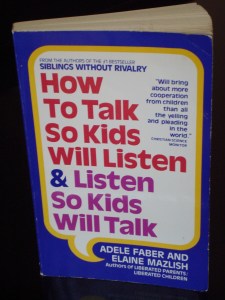
It’s obvious that I’ve been thinking about the intersection of leadership and parenting for a long time. I recently caught up with someone I worked with over 10 years ago. As I told her about my new blog and leadership coaching business, she said that she had fond memories of a book club that I used to run for the program managers at our company. One of her favorite discussions was on How to Talk so Kids Will Listen & Listen so Kids Will Talk by Adele Faber and Elaine Mazlish.

Yup. I asked a group of professionals, most of whom did not have kids, to read a parenting book. In doing so, I asked them to imagine that the title of the book was “How to Talk so TEAMS Will Listen & Listen so TEAMS Will Talk.”  And it worked! We had a great conversation about the book and how to apply it to our work environment.

Do you have a favorite parenting book that has helped shape your leadership style? Please tell me about it by commenting on this post. I look forward to hearing from you.

–Karen

Would you like to vote on my next topic? Click here

© 2012 by Karen Catlin. All rights reserved.